# API without Secrets: Introduction to Vulkan
by Pawel Lapinski
Source code examples for "API without Secrets: Introduction to Vulkan" tutorial which can be found at:
https://software.intel.com/en-us/articles/api-without-secrets-introduction-to-vulkan-preface
Special thanks to Slawomir Cygan for help and for patiently answering my many, many questions!
## Drivers:
Vulkan drivers and other related resources can be found at https://www.khronos.org/vulkan/
## Tutorials:
### [01 - The Beginning](./Project/Tutorial01/)
 #### Introduction to a Vulkan world
##### https://software.intel.com/en-us/api-without-secrets-introduction-to-vulkan-part-1
Tutorial presents how to create all resources necessary to use Vulkan inside our application: function pointers loading, Vulkan instance creation, physical device enumeration, logical device creation and queue set up.
### [02 - Swap chain](./Project/Tutorial02/)
#### Introduction to a Vulkan world
##### https://software.intel.com/en-us/api-without-secrets-introduction-to-vulkan-part-1
Tutorial presents how to create all resources necessary to use Vulkan inside our application: function pointers loading, Vulkan instance creation, physical device enumeration, logical device creation and queue set up.
### [02 - Swap chain](./Project/Tutorial02/)
 #### Integrating Vulkan with OS
##### https://software.intel.com/en-us/api-without-secrets-introduction-to-vulkan-part-2
This lesson focuses on a swap chain creation. Swap chain enables us to display Vulkan-generated image in an application window. To display anything simple command buffers are allocated and recorded.
### [03 - First triangle](./Project/Tutorial03/)
#### Integrating Vulkan with OS
##### https://software.intel.com/en-us/api-without-secrets-introduction-to-vulkan-part-2
This lesson focuses on a swap chain creation. Swap chain enables us to display Vulkan-generated image in an application window. To display anything simple command buffers are allocated and recorded.
### [03 - First triangle](./Project/Tutorial03/)
 #### Graphics pipeline and drawing
Here I present render pass, framebuffer and pipeline objects which are necessary to render arbitrary geometry. It is also shown how to convert GLSL shaders into SPIR-V and create shader modules from it.
### [04 - Vertex Attributes](./Project/Tutorial04/)
#### Graphics pipeline and drawing
Here I present render pass, framebuffer and pipeline objects which are necessary to render arbitrary geometry. It is also shown how to convert GLSL shaders into SPIR-V and create shader modules from it.
### [04 - Vertex Attributes](./Project/Tutorial04/)
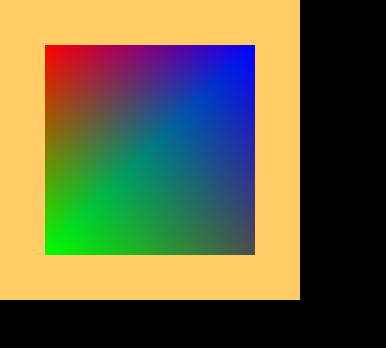 #### Buffers, images and fences
This tutorial shows how to set up vertex attributes and bind buffer with vertex data. Here we also create images, memory objects and fences.
#### Buffers, images and fences
This tutorial shows how to set up vertex attributes and bind buffer with vertex data. Here we also create images, memory objects and fences.